June 20, 2026 – The inaugural event of the Overseas Culture Week under the “Panda & Ecology: A Community of Life” Global Giant Panda Cultural Exchange Program was held in Bonn, Germany. Coinciding with the traditional Chinese Dragon Boat Festival, the event echoed the festival’s spirit of “following the rhythms of nature” and “harmony between heaven and humanity,” which closely align with its advocacy for harmonious coexistence between people and nature. Chengdu and Bonn have been sister cities for over a decade: the former is a panda homeland nurtured by the Minjiang River and a park city, while the latter is an ecological city and land of music on the Rhine. More than 40 Chinese and German guests engaged in in‑depth dialogue on sustainable development, ecological governance, intangible cultural heritage preservation, and industrial synergy.
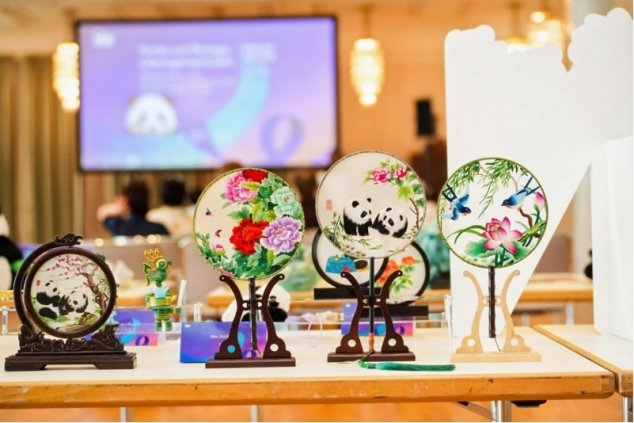
The event commenced with a free tour of the exhibition area, where interactive installations such as the “AI Cloud Hug Panda,” Shu brocade and Shu embroidery, and cultural and creative products featuring giant pandas and Sanxingdui were on display, blending modern technology with traditional culture. Guests were presented with festive zongzi (rice dumpling) ornaments to experience the rich atmosphere of the traditional Chinese holiday.
Subsequently, three documentary trailers produced by Chengdu Radio and Television were screened: The Gaze of Civilizations: When Ancient Shu Meets Ancient Egypt, Witness of Friendship, and The Unceasing Vitality – Roger T. Ames and Chinese Philosophy. Moving from the cross‑temporal encounter between ancient Shu bronze masks and ancient Egyptian golden masks, to the cross‑border friendship witnessed by General Bernard Rouffet, and to Professor Roger T. Ames’ interpretation of the Eastern wisdom of “unceasing vitality,” the films progressively illustrated the core philosophy of “each shining with its own splendour, and together creating a shared beauty.”
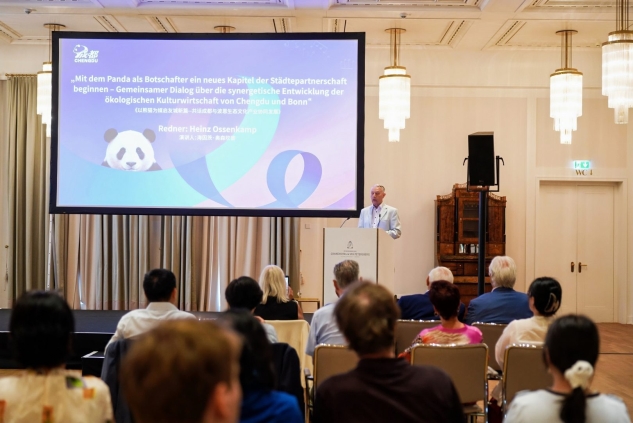
During the keynote session, Heinz Ossenkamp, former Vice Federal Chairman of the German Civil Service Federation and Trade Union (dbb) and current Vice Chairman of the Bonn Senate Club, delivered a speech titled “With the Panda as a Bridge, Opening a New Chapter for Sister Cities – Dialogue on Ecological and Cultural Industry Synergy between Chengdu and Bonn.” A seasoned German political figure deeply engaged in local political, business, and cross‑border affairs, he had previously promoted the integration of traditional Chinese elements into the Rhine Carnival. In his address, he explored the ecological and cultural foundations of both cities – Bonn’s Rhine‑nourished landscape and Beethoven’s musical heritage, and Chengdu’s status as a panda homeland and a park city demonstration zone that implements new development concepts. He proposed leveraging panda culture as a bond to foster synergy in three areas: ecological co‑existence, cultural resonance, and industrial integration. This was followed by a video titled “Bonn–Chengdu Cultural Exchange,” which presented vivid stories of people‑to‑people interactions from the perspective of German students studying in Chengdu.
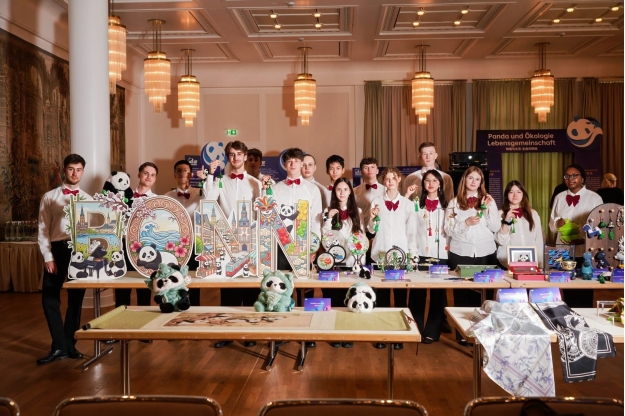
After the keynote, the Bonn branch of the Bo Le Chinese Choir from Germany captivated the audience with children’s choruses of Jasmine Flower and Chengdu. Later, guests experienced traditional Chinese intangible cultural heritage – panda rubbing and paper‑cutting – under the guidance of master artisans.
In the open exchange session, participants engaged in in‑depth discussions on topics such as ecological urban governance, intangible heritage protection, and green industrial cooperation. Many German guests remarked that the event deepened their understanding of Chengdu’s ecological development philosophy and cultural heritage, offering new perspectives for broader cooperation between the sister cities.
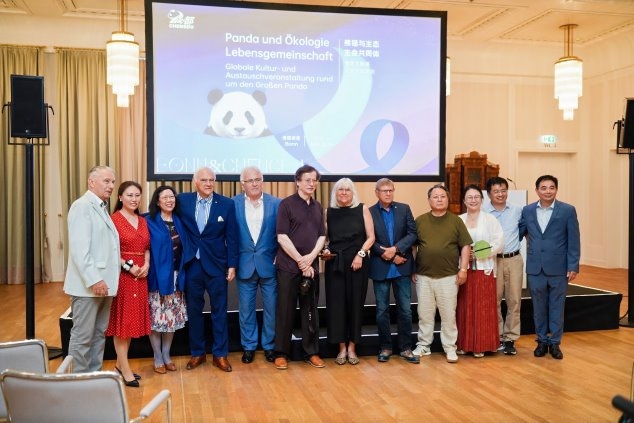
The successful hosting of this event in Bonn, with the giant panda as a trans‑boundary ecological symbol, fostered a profound dialogue between the Eastern philosophy of “unceasing vitality” and Western ecological ethics, providing an inspiring practical model for cities worldwide to explore paths of harmonious coexistence between humanity and nature.
It is learned that the next stop of this cross‑continental cultural dialogue will be in Kuala Lumpur, Malaysia, on June 29. There, the panda will continue to serve as a cultural envoy, helping the seeds of mutual learning among civilizations take root and flourish in diverse soils. |